
Joint Policy Brief Submission to COP31 by SEVEN With Professor Joyeeta Gupta
- November 6th, 2026
In collaboration with SEVEN, Principal Investigator Prof. Joyeeta Gupta has contributed to writing a policy brief submission to the COP31 in Antalya from November 9 until November 20.
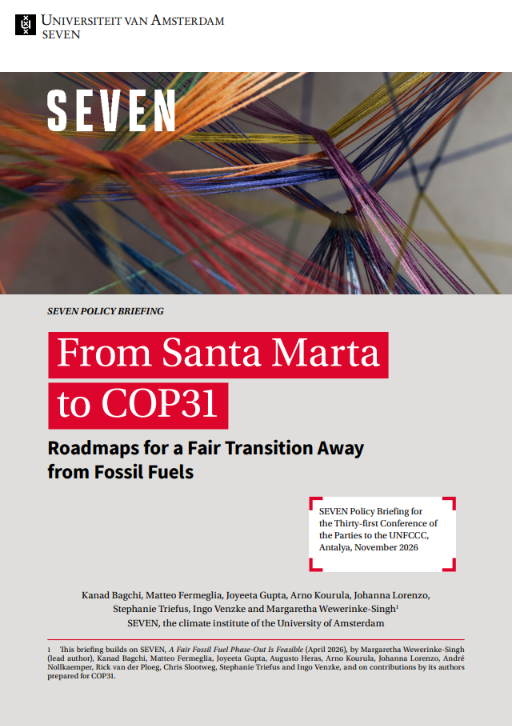
As the COP in Antalya is approaching, SEVEN (University of Amsterdam) has submitted a policy brief on roadmaps for a just phaseout of fossil fuels. Our project’s Principal Investigator Prof. Joyeeta Gupta has contributed to the process, highlighting her research on fossil fuel lock-ins.
Summary
The transition away from fossil fuels is required by the science, which ties fossil fuels to warming and the harm it causes, and by the law. States have long been obliged to prevent significant environmental harm and to cooperate in doing so, and in July 2025 the International Court of Justice confirmed that these obligations extend to their conduct on fossil fuels: a failure to act on production, consumption, exploration licences or subsidies may constitute an internationally wrongful act (2). Parties recognised as much at COP28. What had not happened until April 2026 was for States to convene on how the transition is to be carried out. In Santa Marta, 57 countries did so, and the co-hosts’ report of June 2026 sets out five pathways forward: national and regional roadmaps, coherence across venues, relief from macroeconomic dependence, reformed finance, and the alignment of producers and consumers towards decarbonised trade (3). The task before COP31 is to carry that work into implementation.
This briefing draws on SEVEN’s April 2026 briefing, A Fair Fossil Fuel Phase-Out Is Feasible, and on new contributions from its authors (4). It identifies five structural barriers to phase-out: fossil fuel lock-ins (5), corporate transitions without accountability, unequal burdens, a financial architecture that penalises the countries least able to bear the cost of the transition, and investment treaties that expose climate measures to compensation claims. For each it sets out what the evidence shows and the decision it supports.
At the start of 2026 the remaining carbon budget for 1.5°C stood at little more than three years of current emissions, so these decisions cannot wait (6). On that basis we make five recommendations to Parties at COP31. The first is to commit to timebound, differentiated national plans for a managed phase-out: a planned, government-led wind down of production and use, not one left to markets. The plans are to state which uses of fossil fuels end first and on what grounds, act on demand as well as supply, and not rely on removal, offsets or claims of abatement in place of reductions. Under the obligations set out below, States with greater historical responsibility and capacity must move first and furthest, which for them means halting new expansion now. The second is to agree a common framework for corporate transition plans, with mandatory disclosure and safeguards against the transfer of fossil fuel assets. The third is to place equity, participation and reparation at the core of roadmap design. The fourth is to redirect public finance from fossil fuel subsidies to concessional transition finance, and to reform the multilateral development banks and the treatment of debt. The fifth is to coordinate action on investment treaties so that compensation claims by investors no longer deter States from phasing out fossil fuels.
About
The CLIFF project was financed by the European Research Council (ERC) Advanced Grant under the European Union's Horizon 2020 research and innovation programme.
Grant agreement: No. 101020082
Quick Links
Contact
+31 20 5254366
J.Gupta@uva.nl
Nieuwe Achtergracht 166, 1018 WS Amsterdam